Friday, June 15, 2007

Lectures at Tautavel


Mark Roberts and Matthew Pope were invited this year to present on the results of the Boxgrove excavations at Tautavel as part of Colloque International de tautavel "Les Culture a bifaces du Pleistocene inferieur et moyen dans les monde".


Speaking on biface reduction and landscape use respectively the papers will be presented in forthcoming proceedings from the conference.

Monday, April 02, 2007

Boxgrove Bifaces at The British Museum


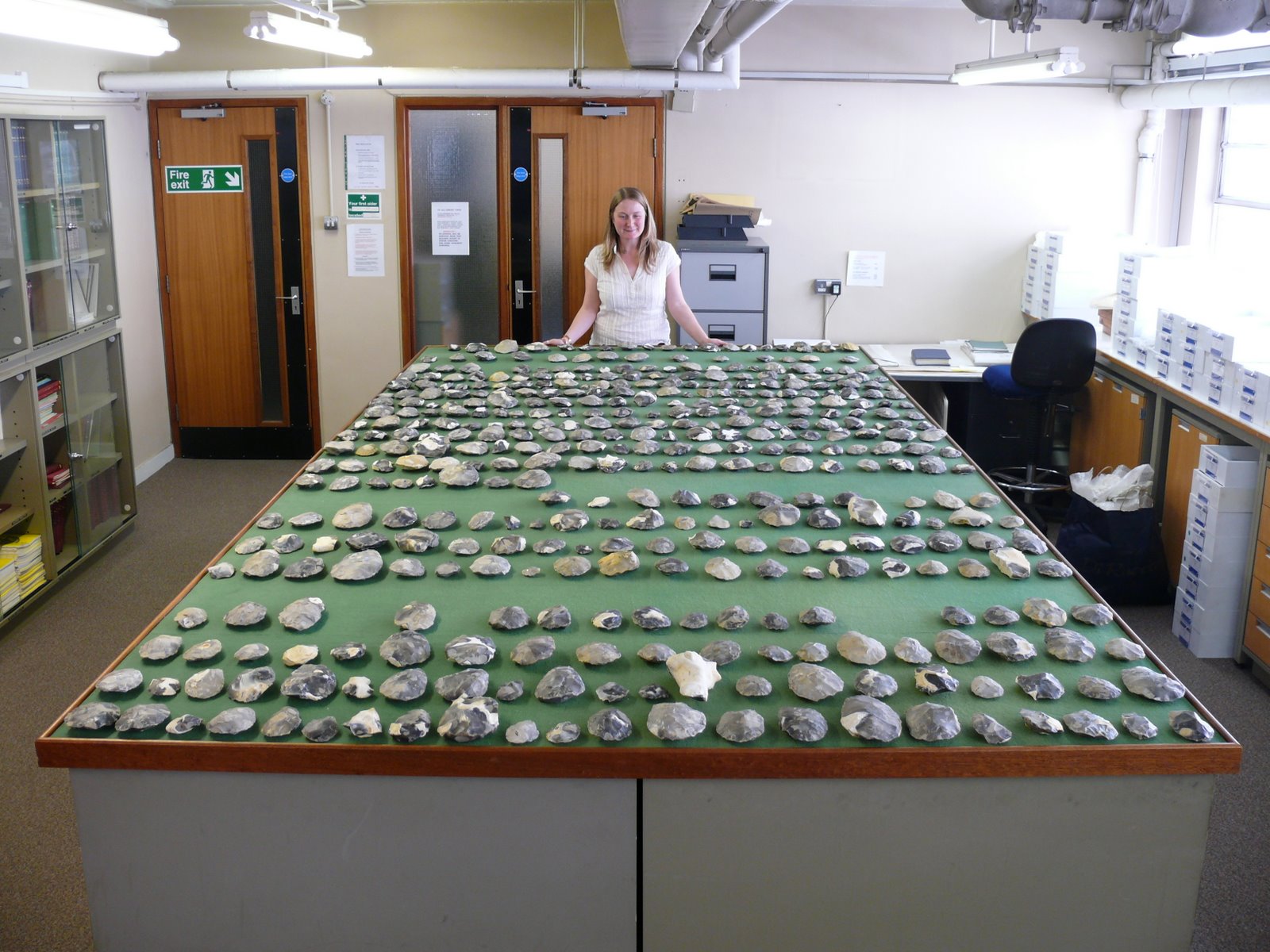
The Boxgrove Project would like to thank the team at Franks House (in particular Claire Fisher) for undertaking the final cataloguing and careful packing of the bifaces from the Q1/B waterhole site. In excess of 400 of these tools were measured, check against the inventory, re-marked and placed within indiidual place holders in drawers at the British Museum store.


Prior to packing, Claire Fisher laid out the tools for a chance to see them in their splendid totality. A truley astonishing site, the bifaces shown in this photograph represent an unparalelled collection of mint-condition tools, each one discarded within a discrete location during a fairly limited time span.

Monday, January 15, 2007

Valdoe Post-excavation Phase Begins

Following a successful year of excavation at the Valdoe site we are now engaged in preparing for the Assessment Phase. During this stage of the project a team of specialists are brought together to work on different aspects of the recovered material (stone tools, fauna, pollen, ostracods) to assess the potential for further detailed analysis. Once the go-ahead is given the team will begin work on a small sample of material from the site and together we will build a case for further work if its considered warranted.

Wednesday, November 01, 2006

Palaeolandsurfaces Revealed in Extraction Area.


As our test pits are opened up ahead of extraction they are revealing in-situ landsurfaces across the entire north-western part of the quarry. In each test pit small quantities of in-situ knapping debitage are present showing that this was an area actively occupied by Middle Pleistocene humans. Perhaps on the fringe of key hunting and butchery areas. We have yet to locate these in the Valdoe environs but the quantities of background evidence in the form of diffuse scatter of flakes makes their local presence a virtual certainty.

Sunday, October 01, 2006

Valdoe Contingency Phase Begins

English Heritage, through their administration of Aggregates Levy Sustainability Fund, have given the go-ahead to the Valdoe Contingency Phase. This three-month project will work ahead of renewed extraction to sample sediments identified as containing in-situ archaeology in the north-western part of the Valdoe Quarry.The Contingency Project has provision for five archaeological test pits and a further five boreholes. Through these the nature of the sedimentary sequence, stone age archaeology and environmental character will be ascertained

Sunday, June 11, 2006

Assessment Phase Ends

The initial Assessment Phase of fieldwork has now finished. Since February a series of seven boreholes, five test pits and numerous exposure recordings have allowed us to accurately produce a detailed model of the geology in the Valdoe Quarry.We have been given an enormous amount of uninhibited access to the Quarry through the continued, kind permission of Dudmans LTD.As a result we are now able to predict where deposits containing archaeology and environmental indicators are luckily to be preserved. Should any further extraction take place we shall therefore be in a position to develop a suitable plan for mitigation/rescue.

Sunday, April 02, 2006

In-Situ Artefacts Found


Test Pits 5 and 6 have both produced in situ artefacts this week. At both localities we now have definite evidence for a human presence in the form of small quantities of late stage biface thinning debitage. The evidence, combined with local surface finds of handaxes and further artefacts in the overlying Head Deposits, suggests the habitual use of the Lavant Valley mouth during the same period that Boxgrove was occupied. Unless behaviour was significantly different in this context, the evidence suggests the likelihood of larger, more intensively occupied locales are present within the vicinity of the Valdoe.